
Exploring Shockwave Therapy for Soft Tissue and Movement Concerns
Physical activity, work demands, sports, repetitive movements, and everyday tasks can place stress on muscles, tendons, fascia, and other soft tissues. When discomfort or reduced function continues, people may look for non-invasive options that can fit into a broader rehabilitation plan.
Shockwave therapy is one treatment approach used in physiotherapy and musculoskeletal care. It uses acoustic pressure waves directed toward a selected area of the body. Depending on the condition, treatment settings, tissue involved, and clinical assessment, it may be considered as part of a rehabilitation program.
For people in Beaumont, Alberta, learning how this treatment works and where it may fit can make conversations with a physiotherapist more productive. At The Bright Physio & Mindfulness Massage, treatment decisions can be based on the individual’s condition, symptoms, movement, activity demands, and overall rehabilitation needs.
1. What Is Shockwave Therapy?
Shockwave therapy uses acoustic waves to deliver mechanical energy to a targeted area. There are different forms of pressure-wave technology, including radial pressure waves and focused shockwaves. Although these terms are sometimes used interchangeably, they have different physical characteristics and ways of delivering energy into tissue.
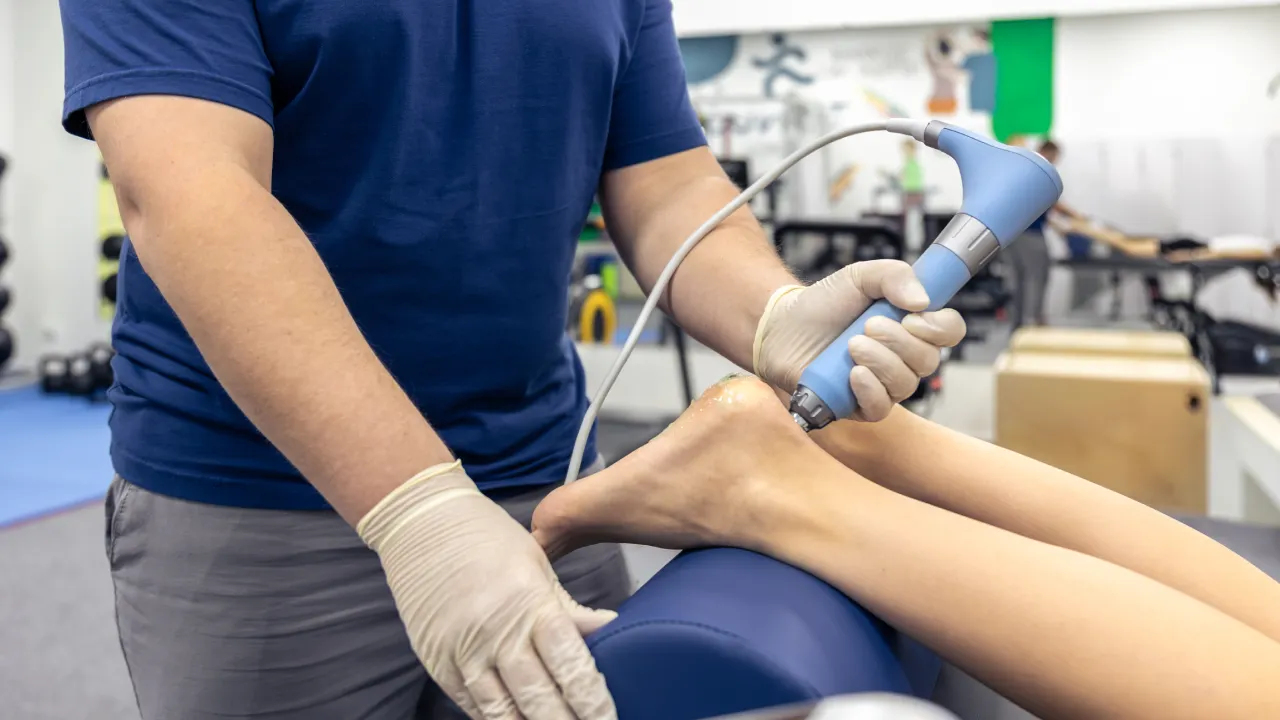
During a session, a treatment applicator is placed against the skin over the selected area. The device produces repeated pressure waves. Treatment parameters can vary according to the tissue being treated and the clinical goal.
The treatment is non-invasive, meaning there is no incision or surgical procedure involved. Some people may feel discomfort during application, and temporary redness, bruising, soreness, or sensitivity can occur afterward.
It is important to view this therapy as one component of care rather than a universal solution for every musculoskeletal condition.
2. Shockwave therapy May Be Considered for Certain Tendon Problems
One of the areas where shockwave therapy has been studied is tendinopathy. Tendons connect muscles to bones and can become irritated or undergo changes when exposed to repeated loading.
Examples of conditions that may be considered for shockwave treatment include certain cases of:
- Achilles tendinopathy
- Plantar heel pain
- Tennis elbow
- Patellar tendinopathy
- Some chronic tendon-related conditions
- Certain calcific tendon problems
Research findings vary depending on the condition and treatment method. A 2026 systematic review examining radial and focused shockwave treatment for upper- and lower-limb tendinopathies found no clear overall superiority between the two approaches, with the certainty of evidence ranging from low to very low for several outcomes.
This means a treatment plan should be based on the specific diagnosis rather than assuming that shockwave treatment is suitable simply because a tendon is involved.
3. How Shockwave Therapy May Help Support Soft Tissue Recovery
A common question is how shockwave therapy may fit into soft-tissue rehabilitation.
The mechanical energy delivered to the treatment area may influence local tissue responses. Research has explored effects involving blood flow, cellular activity, tissue remodeling, and pain-related processes. However, the exact biological response can vary according to the type of wave, energy level, treatment frequency, and condition being treated.
The goal is not simply to apply waves to an uncomfortable area. A physiotherapist may first assess movement, strength, tissue loading, symptom behavior, and functional limitations.
A rehabilitation program may then combine shockwave treatment with exercises, activity modification, mobility work, strengthening, and gradual progression of physical load.
Research on soft-tissue disorders has reported improvements in some outcomes, while other studies have produced mixed findings.
This is why shockwave treatment should be viewed within the context of the complete rehabilitation plan.
4. It Is Not Suitable for Every Type of Injury
Is shockwave therapy suitable for every injury? No.
The type, location, severity, and stage of an injury all matter. A complete tendon rupture, acute infection, certain tumors, pregnancy, significant blood-clotting problems, and treatment near certain sensitive structures may be reasons to avoid or modify treatment.
People with significant tendon damage may also require imaging or additional assessment before treatment. Clinical recommendations note that advanced tendon or soft-tissue injuries require particular care when considering higher-energy treatment.
The type of shoulder condition also matters. For example, a 2025 clinical practice guideline for rotator cuff tendinopathy distinguishes between calcific and non-calcific conditions when discussing extracorporeal shockwave treatment.
Therefore, a proper assessment should come before deciding whether this approach is appropriate.
5. Shockwave therapy may be used alongside exercise.
Another important fact is that shockwave therapy does not necessarily replace active rehabilitation.
Exercise can play an important role in improving strength, movement capacity, tissue tolerance, and functional ability. Depending on the condition, a physiotherapist may use progressive strengthening or other exercises alongside a treatment modality.
For someone with a tendon-related problem, the rehabilitation plan might involve gradually increasing the load placed on the affected structure. The timing and amount of activity can depend on symptoms and functional capacity.
Clinical best-practice literature also emphasizes load management when treating tendon and soft-tissue conditions.
This approach can help connect treatment sessions with everyday activities, exercise, work requirements, and sport.
6. Treatment Response Can Vary from Person to Person
People sometimes expect a single treatment to produce the same result for everyone. Research does not support that assumption.
The response to shockwave therapy can depend on factors such as
- The underlying condition
- How long symptoms have been present
- The tissue involved
- Treatment parameters
- Activity levels
- Overall physical capacity
- Other rehabilitation strategies
- Individual response to treatment
For example, NICE notes that evidence for shockwave treatment in Achilles tendinopathy has been inconsistent, with some studies reporting symptom and functional improvements while the overall evidence remains uncertain.
Similarly, evidence for shoulder conditions varies according to whether the tendon problem involves calcification.
For this reason, treatment progress should be monitored rather than judged solely by how an individual feels immediately after a session.
7. Shockwave therapy Should be selected after an assessment.
A major fact about shockwave therapy is that treatment selection should follow a clinical assessment.
A physiotherapist may look at the location of symptoms, movement patterns, strength, activity limitations, injury history, and other factors before deciding whether shockwave treatment has a place in the plan.
The assessment can also help identify situations where another approach may be more appropriate.
For instance, a sudden injury involving significant weakness, loss of function, or suspected tissue rupture may require further evaluation before any pressure-wave treatment is considered.
Similarly, symptoms caused by an issue that is not appropriate for shockwave treatment should not be treated simply because the treatment is available.
Potential Uses of Shockwave Therapy in Physiotherapy
Potential applications vary according to the condition and the available evidence. Research has examined shockwave treatment for various musculoskeletal conditions, particularly tendon and soft-tissue disorders.
Some commonly discussed areas include
Plantar Heel Conditions
Certain cases of persistent plantar heel pain have been studied with shockwave treatment. Treatment may be considered when symptoms continue despite an appropriate rehabilitation program.
Tendon-Related Conditions
Some chronic tendinopathies involving the Achilles tendon, elbow, knee, or other regions have been investigated in clinical studies.
Calcific Tendon Problems
Shockwave treatment has also been studied for calcific tendinopathy, particularly around the shoulder. However, recommendations differ across health systems, and evidence quality can vary. NICE, for example, has stated that evidence for calcific shoulder tendinopathy was insufficient to establish efficacy and recommended further research.
Selected Soft-Tissue Conditions
Research has examined shockwave treatment for several soft-tissue disorders. Results vary by diagnosis, treatment protocol, and study quality, so treatment selection should remain condition-specific.
What Can You Expect During a Session?
Before treatment, the physiotherapist may assess the target area and determine whether the treatment is appropriate.
During the session, a handheld applicator is placed against the skin. Pressure waves are delivered to the selected region. The sensation can vary depending on the treatment area and intensity.
Some people experience temporary soreness, redness, bruising, or sensitivity following treatment. These reactions are generally described as temporary, although individual responses vary.
Your physiotherapist may also discuss activity levels after treatment. Avoiding sudden increases in physical load can be important, particularly when treating tendon or soft-tissue conditions.
Is Shockwave Therapy Right for You?
The answer depends on your condition.
If you have persistent tendon-related symptoms, plantar heel problems, certain soft-tissue conditions, or a calcific tendon issue, a physiotherapy assessment can help determine whether shockwave treatment is worth considering.
However, not every injury should receive this treatment. Acute injuries, suspected tendon ruptures, infections, pregnancy, certain cancer-related conditions, and some blood-clotting disorders require caution or avoidance.
The goal should be to identify the cause of the problem and select treatment based on clinical findings rather than choosing a modality simply because it is available.
5 Frequently Asked Questions
1. What is shockwave therapy used for?
It is commonly studied for certain tendon and soft-tissue conditions, including some cases of plantar heel pain, tendinopathy, tennis elbow, Achilles-related problems, and calcific tendon conditions.
2. Does shockwave therapy hurt?
The sensation varies between people and treatment areas. Some individuals experience discomfort during application. Temporary soreness, redness, bruising, or sensitivity can occur afterward.
3. How many sessions are needed?
There is no single number that applies to every condition. The number and frequency of sessions depend on the diagnosis, symptoms, treatment parameters, and response to care.
4. Can shockwave therapy be combined with exercise?
Yes. It may be incorporated into a broader physiotherapy program that includes strengthening, mobility work, activity modification, and gradual loading when appropriate.
5. Is shockwave therapy suitable for every injury?
No. Certain injuries and health conditions may make shockwave treatment unsuitable or require additional assessment first. A physiotherapist can assess the condition and determine whether this treatment has a reasonable role.
Take the Next Step.
If ongoing tendon or soft-tissue symptoms are affecting your work, exercise, walking, sports, or daily activities in Beaumont, an assessment can help identify what may be contributing to the problem.
At The Bright Physio & Mindfulness Massage in Beaumont, the physiotherapy team can assess your condition and discuss whether shockwave therapy may fit within your rehabilitation plan. Treatment can be considered alongside appropriate exercise, movement work, and activity planning when clinically suitable.
Contact The Bright Physio & Mindfulness Massage in Beaumont, AB, to schedule an assessment and discuss your symptoms and available physiotherapy options.
Phone: +1 780-737-1019
Address: 4904 30 Ave 105, Beaumont, AB T4X 3G3, Canada